
Why you keep buying things you didn’t plan to
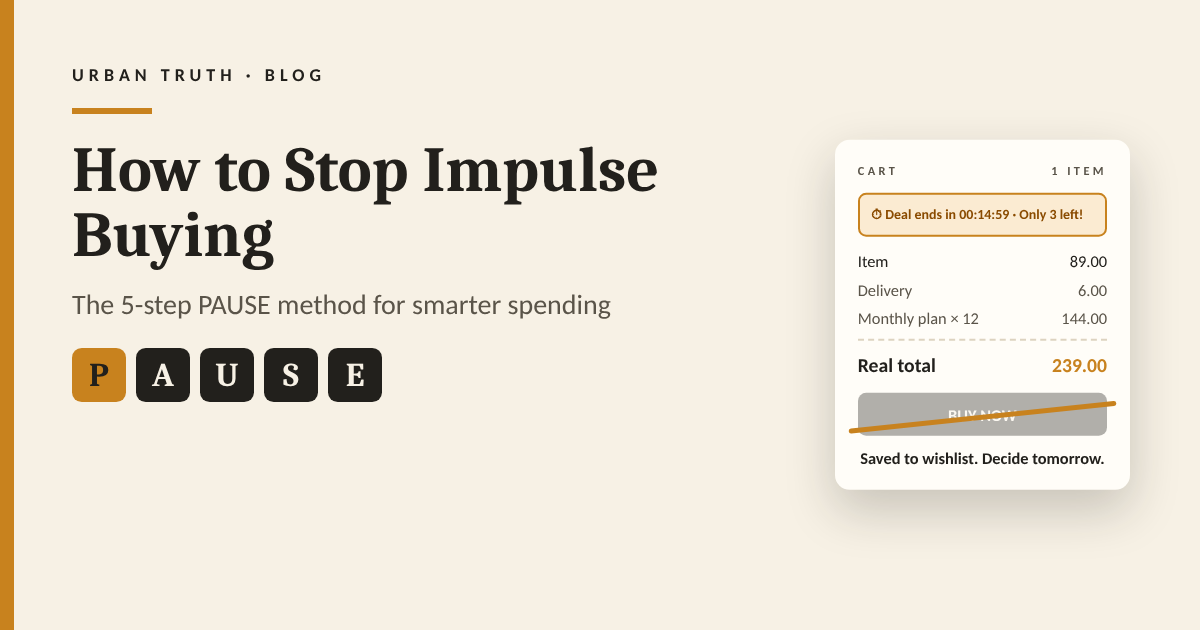
It’s 11 p.m. You’re tired, scrolling, and an ad shows you something you actually need. There’s a countdown timer. “Only 3 left.” Your card is in your hand before you’ve checked your budget.
If you want to know how to stop impulse buying, start here: it’s usually not a willpower problem. Most impulse purchases happen when you’re tired, stressed, rushed, or being pushed by a page designed to make waiting feel like losing.
That’s why “just stop spending” rarely works. What works better is a short, repeatable process you can use in the moment, even on a bad day.
This guide walks you through one. It’s called PAUSE, five quick questions that slow a purchase down just enough for you to choose on purpose. You won’t need a spreadsheet for every snack. You’ll use it for purchases, subscriptions, and commitments that actually matter.
What is impulse buying?
Impulse buying is a purchase made faster than you would choose to, usually because something outside the decision is pushing you. The item might be useful. The problem is that pressure, not your own judgment, made the call.
That pressure usually comes from one of three places:
- Manufactured pressure. Countdown timers, “last chance” banners, “only 2 left in stock,” or a salesperson who says the price is only good today. Someone benefits from your quick yes.
- Emotional pressure. Buying to feel better after a hard day, to end boredom, or to celebrate. This is often called emotional spending.
- Borrowed pressure. A friend’s excitement, a group order, or the wish to end an awkward moment at the checkout.
Noticing which kind you’re facing is the first step to stopping it. Pressure that you can name has less control over you.
How to stop impulse buying in 5 steps: the PAUSE method
PAUSE takes about two minutes once you’re used to it. Use it whenever a purchase involves real money, a recurring charge, or a feeling of being rushed.
- P: Pause the pressure. Ask: “What is pushing me to decide right now? Is the deadline real?” A sale ending at midnight is a deadline. Your boots splitting is a need. But they’re not the same thing. If the only cost of waiting is losing this exact deal, you can usually wait.
- A: Ask what matters. Ask: “What outcome do I actually want?” Maybe it’s dry feet at work, not the newest boots. Naming the real goal often shows you cheaper or better options.
- U: Understand the full cost. The price tag is only part of it. Add delivery, fees, accessories, monthly charges, and the time it takes. Then ask what else that money was meant for.
- S: Select the next safe step. Pick a small, reversible action instead of a final yes. Add it to a wishlist. Check the return policy. Compare two other shops. Decide by tomorrow morning.
- E: Evaluate and adjust. A week later, look back. Did you use it? Would you buy it again? Keep one lesson and let the rest go.
The most useful single step is the first. Try this honest delay sentence: “I don’t buy after 10 p.m. If I still want it tomorrow and it fits my budget, I’ll buy it then.” It isn’t a ban. It’s a short gap where you get your judgment back.
Count the full cost, especially with subscriptions
Subscriptions are where small impulse purchases quietly turn into big ones. A free trial is an easy yes. Forgetting to cancel it is easier.
Use this simple formula before you sign up:
Total cost = upfront price + (recurring price × number of times it repeats) + extra fees
Keep time as a separate number. An hour isn’t automatically worth a fixed amount of money, and mixing the two hides what you’re really giving up.
Worked example (fictional). Dev reviews his subscriptions over 12 months:
| Subscription | Monthly cost | 12-month cost | Does he use it? |
|---|---|---|---|
| Fitness app | 12 | 144 | No |
| Video service A | 10 | 120 | Weekly |
| Video service B | 15 | 180 | No, the show ended |
| Music | 11 | 132 | Daily |
| Cloud storage | 3 | 36 | Holds family photos |
| Total | 51 | 612 |
Dev cancels the two he doesn’t use and saves 324 over the year. He keeps the other three because they match what he values.
That’s the point of full-cost thinking. It’s not a reason to say no to everything. It’s a way to say yes on purpose.
Try it today: open your bank statement, find one recurring charge, and multiply it by 12. Decide whether it stays.
Make pausing easier than buying
Most impulse spending happens on hard days, when you’re tired, stressed, or lonely. On those days you won’t run through five steps. You need a version so small it still works.
Build your pause habit in three layers:
- Full PAUSE for big purchases on calm days.
- Short PAUSE for ordinary days: “Is this urgent? What does it really cost? What’s the smallest next step?”
- Minimum pause for your worst days: one action only. Don’t buy tonight unless it’s truly urgent.
Then change your environment so the pause happens almost by itself:
- Remove saved card details from the shopping apps you use most.
- Turn off sale and “price drop” notifications.
- Set a personal rule, such as no non-essential purchases after 10 p.m.
- Set a phone reminder two days before every free trial ends.
- Keep a wishlist. If you still want something after 24 hours, and it fits your budget, buy it without guilt.
Missing a day doesn’t undo the habit. The goal isn’t a perfect streak. It’s coming back to the pause without punishing yourself.
When waiting is the wrong move
Pausing is for pressure that doesn’t deserve your speed. Some deadlines are real.
If the purchase is about safety, health, housing, or a genuine legal deadline, act first. A broken heater in winter, medicine you need, or a repair that has to be booked today deserves a fast answer. Spend thirty seconds checking it’s legitimate, then move.
It’s also worth saying plainly: not every money struggle comes from impulse buying. Emergencies, caregiving, low pay, and rising prices are real. Full-cost thinking shows you the trade-off. It can’t create money that isn’t there.
And if your spending feels out of your control, or it’s causing serious debt or distress, talk to a qualified professional or a local financial counselling service. A blog post isn’t a substitute for personal support.
Frequently asked questions
What is the 24-hour rule for impulse buying?
The 24-hour rule means waiting a full day before buying anything you didn’t plan to buy. If you still want it after 24 hours and it fits your budget, you buy it. The wait gives you time to check the full cost and compare options without sales pressure.
How do I stop impulse buying online?
Remove saved card details, turn off sale notifications, and use a wishlist instead of the cart. Set a personal rule, such as no shopping after 10 p.m. Online stores are designed to make buying fast, so the goal is to add a small, deliberate delay.
Why do I impulse buy when I’m stressed?
Buying something can bring quick relief when you’re tired or upset. That relief is real but short. A minimum pause rule, such as not buying anything tonight, protects you on the days you have the least energy to decide.
Is all impulse buying bad?
No. A spontaneous purchase that fits your budget and values can be fine. The problem is when pressure, not your own judgment, makes the decision repeatedly.
How do I stop impulse buying subscriptions?
Set a reminder two days before any free trial ends. Once a year, list every recurring charge, multiply each by 12, and cancel anything you wouldn’t sign up for again today.
Start with one purchase this week
You don’t need to fix every spending habit at once. Pick one purchase you’re considering this week and walk it through PAUSE: name the pressure, ask what matters, count the full cost, choose a small next step, and look back later.
Bitter truth: a fast yes is not always a free yes. Sometimes it’s a bill your future self pays without being asked.
If you want the full system, Before You Say Yes: The Decision Reset Kit turns PAUSE into a seven-day route with daily 15–25 minute lessons. It includes:
- An offline interactive toolkit with a guided PAUSE worksheet, decision journal, and 30-day practice tracker
- A 49-page ebook (PDF, EPUB, and Markdown)
- A fillable PDF workbook with a print-friendly version
- An Excel spreadsheet with a full-cost calculator that keeps money and time separate
- 24 short boundary scripts for the moments when the pressure comes from people, not ads
This article is educational and is not financial advice. Examples are fictional.
Daily Bitter Truths. Real Life. Real Growth. — Urban Truth